
Parent Communication Without WhatsApp at Your Club
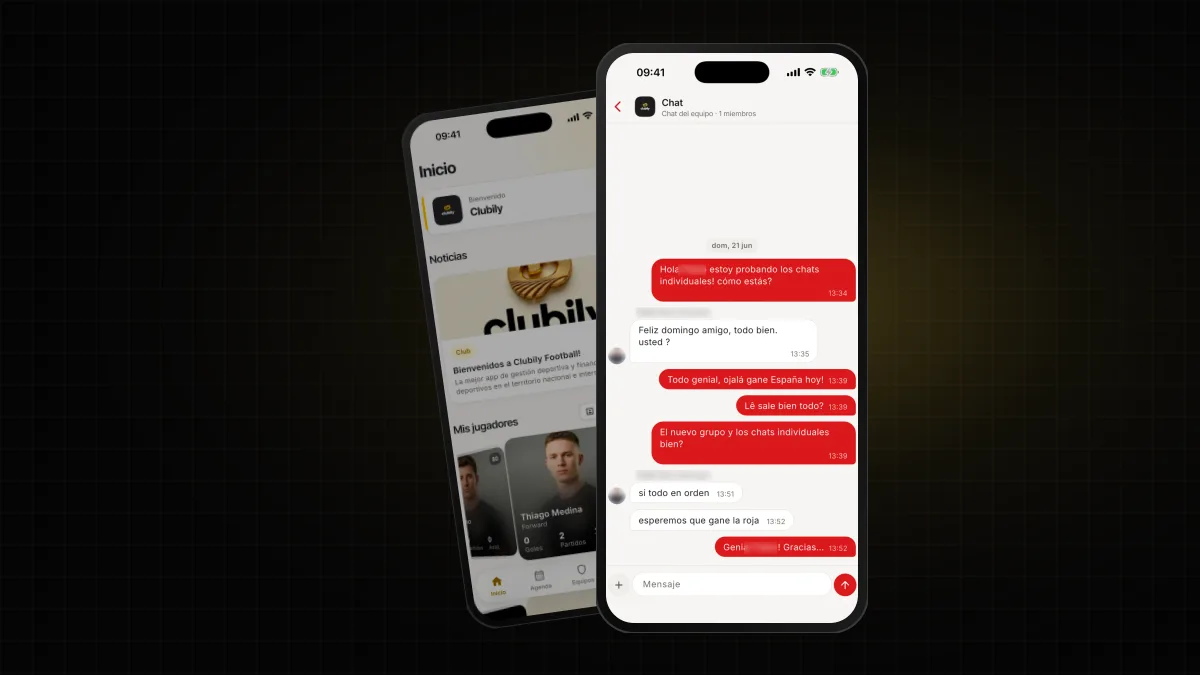
A WhatsApp alternative for sports clubs: how to communicate with parents, protect children's data under the GDPR and keep club announcements in order.
To communicate with parents at a youth football club without WhatsApp groups, move club messages into a dedicated tool with one channel per team, a separate space for official announcements, match call-ups, a shared calendar and permissions based on each person's role. That way parents' and children's phone numbers stop circulating among dozens of people, important notices don't get buried, and the club keeps better control of the personal data it handles, something the GDPR asks for with particular care when children are involved.
Why do WhatsApp groups cause problems at a grassroots football club?
WhatsApp is convenient because everyone already has it, but a group chat was never designed to run a children's team. These are the problems clubs run into again and again:
- Exposed phone numbers: in a group, members can see each other's numbers. An age-group chat brings together families who don't know each other, and those numbers can easily be copied or forwarded.
- Lost announcements: a change of kick-off time ends up buried under a hundred messages of congratulations and photos.
- Noise and arguments: complaints about team selection in a group of 25 families escalate quickly, and the coach ends up moderating instead of coaching.
- Children in groups with adults: once players have their own phones, they can easily end up in chats with adults outside their family, with no clear club policy.
- No roles, no structure: a message from the club secretary carries the same weight as any other comment, and at the start of a new season nobody knows who should still be in the group.
None of this is the fault of coaches or parents. The club is simply using a personal messaging app for an organisational job.
What does the GDPR say about children's data at a sports club?
What follows is a general explanation, not legal advice. Every club's situation is different, so it is worth reviewing yours with a data protection professional.
The General Data Protection Regulation (GDPR) applies across the European Union, and a club that organises communication with its teams processes personal data: names, phone numbers, photos, age groups. Several of its core principles have a direct impact on how you talk to parents:
- Lawful basis (Article 6): every processing activity needs a legal basis. Consent is one of them, but not the only one; which one applies to each case is exactly what to check with a professional.
- Purpose limitation and data minimisation (Article 5): data is collected for specific purposes, and only what is necessary. A phone number given to hear about training sessions shouldn't simply become visible to an entire group.
- Confidentiality (Article 5): the club must take measures so that data isn't accessible to people who shouldn't see it.
- Specific protection for children (Recital 38): the regulation recognises that children merit specific protection of their personal data.
On age, the European Commission explains that when an organisation processes a child's data on the basis of consent, below an age set by each EU country, between 13 and 16, it needs the consent of the child's parent or guardian. In Spain, for example, the Spanish Data Protection Agency (AEPD) states that this age is 14. Your national data protection authority can confirm the threshold in your country.
The practical takeaway is not that WhatsApp is banned. It is that the club should know which data it processes, why, who can see it and on what legal basis. For that analysis, speak to a lawyer or a data protection officer.
What communication best practices work with parents?
With or without an app, these guidelines bring order to any grassroots club:
- One channel per team. Each family only receives what concerns their child's age group.
- Official announcements kept apart from chat. Club news goes in a space where it won't trigger a hundred replies.
- Written call-ups, sent in advance. Who is playing, where and at what time, in a fixed place rather than a voice note.
- A single calendar. Matches and training sessions in one club and team calendar, always up to date.
- Private messages for personal matters. An injury or an unpaid fee is discussed privately with the family, never in front of the group.
- Clear roles. Club officials post announcements, coaches manage their team and parents receive what is relevant to them.
- A clean-up every season. When players move up an age group or leave the club, people leave the channels that no longer apply to them.
What makes a club app a good WhatsApp alternative for sports clubs?
| Criterion | WhatsApp groups | Club app (Clubily) |
|---|---|---|
| How parents are added | With their personal number, group by group | With their account in the app, by team and role |
| Official announcements | Mixed in with the chat | Club news in its own space |
| Call-ups | A message or image that gets lost | Call-ups in the app |
| Calendar | An image or a pinned message | Club and team calendar |
| Private conversations | From the coach's personal phone | Individual chats in the app |
| Permissions | Group admin or nothing | Roles with different permissions |
How does Clubily handle communication with parents?
Clubily is a sports club management app from a Spanish company based in Madrid, "created by club people, for club people". For communication with parents, it brings everything into one place:
- Team and individual chats: each team's conversation and private messages, inside the club's app rather than in personal groups.
- Club news: official announcements, kept separate from the chat.
- Club and team calendar: matches and training sessions in one place.
- Call-ups: each match squad, published in the app.
- Roles with different permissions: club administrators, coaches, players and parents see and do different things.
Clubily runs on iOS and as a web app in any browser, including on Android phones (the Android app has not been released yet), and it is available in English, Spanish, French, German and Italian.
Clubily Team costs €9.99/month for one team, and Clubily Club, for 2 to 50 teams, starts at €17.98/month. On the Club plan, chats are an optional add-on at €10/month. If you oversee several age groups, you may also like our article on multi-team coordination for sporting directors.
How do you move from WhatsApp to a club app?
Announce a switchover date and explain why: better organisation and protection of players' data. Set up your teams and players (you can import them from a CSV file), invite the parents and publish the first call-up and the calendar in the app so everyone has a reason to log in. Once the switch is complete, stop using the old groups.
Frequently asked questions
Is it illegal to use WhatsApp at a youth football club?
There is no general yes-or-no answer. It depends on which data is processed, on what legal basis and with what safeguards. For your specific case, consult a data protection professional.
At what age can a child consent to the processing of their data?
According to the European Commission, each EU country sets that age between 13 and 16. In Spain, the AEPD states that it is 14; below that age, parents or guardians give consent.
Does Clubily work on Android?
Yes, through the web app in the phone's browser. The native app is available on iOS; the Android app has not been released yet.
How much do chats cost on Clubily?
On the Club plan, chats are an optional add-on at €10/month, on top of €8.99 per team for the first two teams and €7.99 per team from the third (monthly billing).
Bring order to your club's communication
If you want parents to get call-ups, announcements and the calendar in one place, without sharing phone numbers in groups, take a look at Clubily's features and get started with the Club plan.